
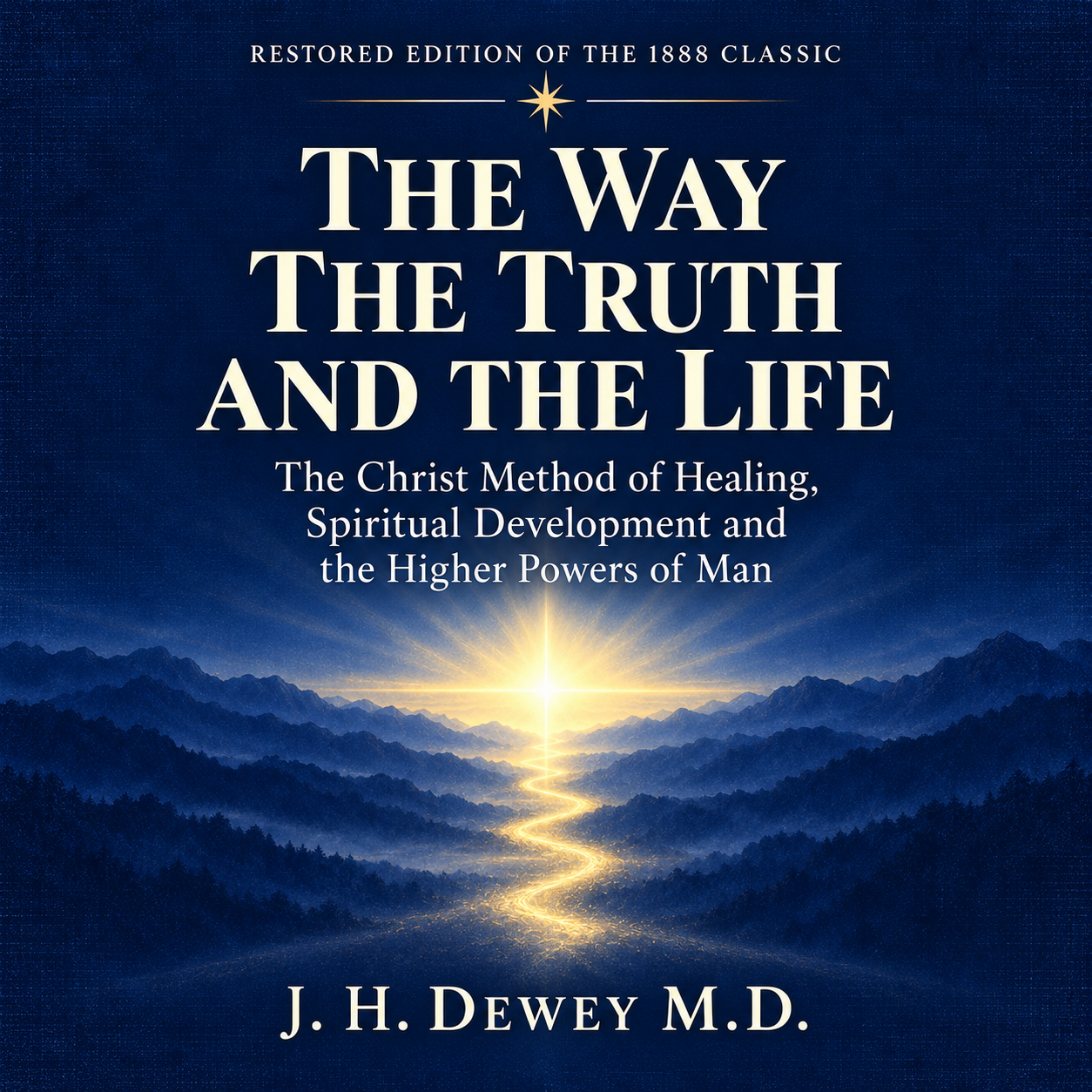
The Way, the Truth and the Life: The Christ Method of Healing, Spiritual Development and the Higher Powers of Man (Audiobook)
Listening time: 10 hr 33 min
What if the healing works of Jesus were not miracles reserved for one man, but demonstrations of a spiritual law that others could learn to understand and apply?
First published in 1888, The Way, the Truth and the Life is one of the remarkable early works of Christian metaphysics to emerge before the New Thought movement had fully taken shape.
Physician and metaphysical teacher John Hamlin Dewey approached the life of Christ with a radical proposition: Jesus was not simply an object of worship, but the supreme example of what human beings might become through spiritual awakening, disciplined thought, faith and conscious union with the Divine.
For Dewey, the works of Christ revealed a practical method.
Healing. Spiritual development. Inner illumination. The awakening of powers latent within the human mind and soul.
Across this substantial work, Dewey explores the relationship between mind and body, the prayer of faith, mental and spiritual healing, concentration, intuition, psychometry, seership, the development of the inner senses and what he regarded as the higher possibilities of human consciousness.
At the centre of everything is one extraordinary idea:
Christ came not only to reveal the nature of God, but to demonstrate the way by which humanity itself might rise into a higher expression of life.
Dewey belonged to the formative generation from which modern metaphysical Christianity and New Thought emerged. His writings circulated in the same remarkable spiritual world as Emma Curtis Hopkins, M. E. Cramer, Annie Rix Militz, Charles and Myrtle Fillmore and other pioneers who sought to recover the practical spiritual principles they believed lay behind the teachings of Jesus. Dewey's books were promoted within the early Unity movement, and later historical scholarship has identified his work as an important influence upon the Fillmores.
Readers familiar with Unity, Divine Science, New Thought, Christian metaphysics, mind healing and the early literature of spiritual transformation will find in Dewey a fascinating voice from the movement's formative years.
Yet this is more than a historical curiosity.
Dewey asks questions that remain strikingly modern:
Can thought influence the body?
What is faith when understood as a practical force rather than a belief?
Can the spiritual faculties of human beings be deliberately developed?
Was the life of Jesus intended to be admired from a distance, or followed as a method?
His answer is uncompromising. The powers manifested in the life of Christ point, in Dewey's view, towards possibilities hidden within humanity itself.
This carefully restored edition preserves the language, argument and distinctive character of Dewey's 1888 work while presenting it clearly for a new generation of readers.
For readers of classic New Thought, Christian mysticism, metaphysical healing and the forgotten pioneers of mind and spirit, this is a work worth rediscovering.